
About
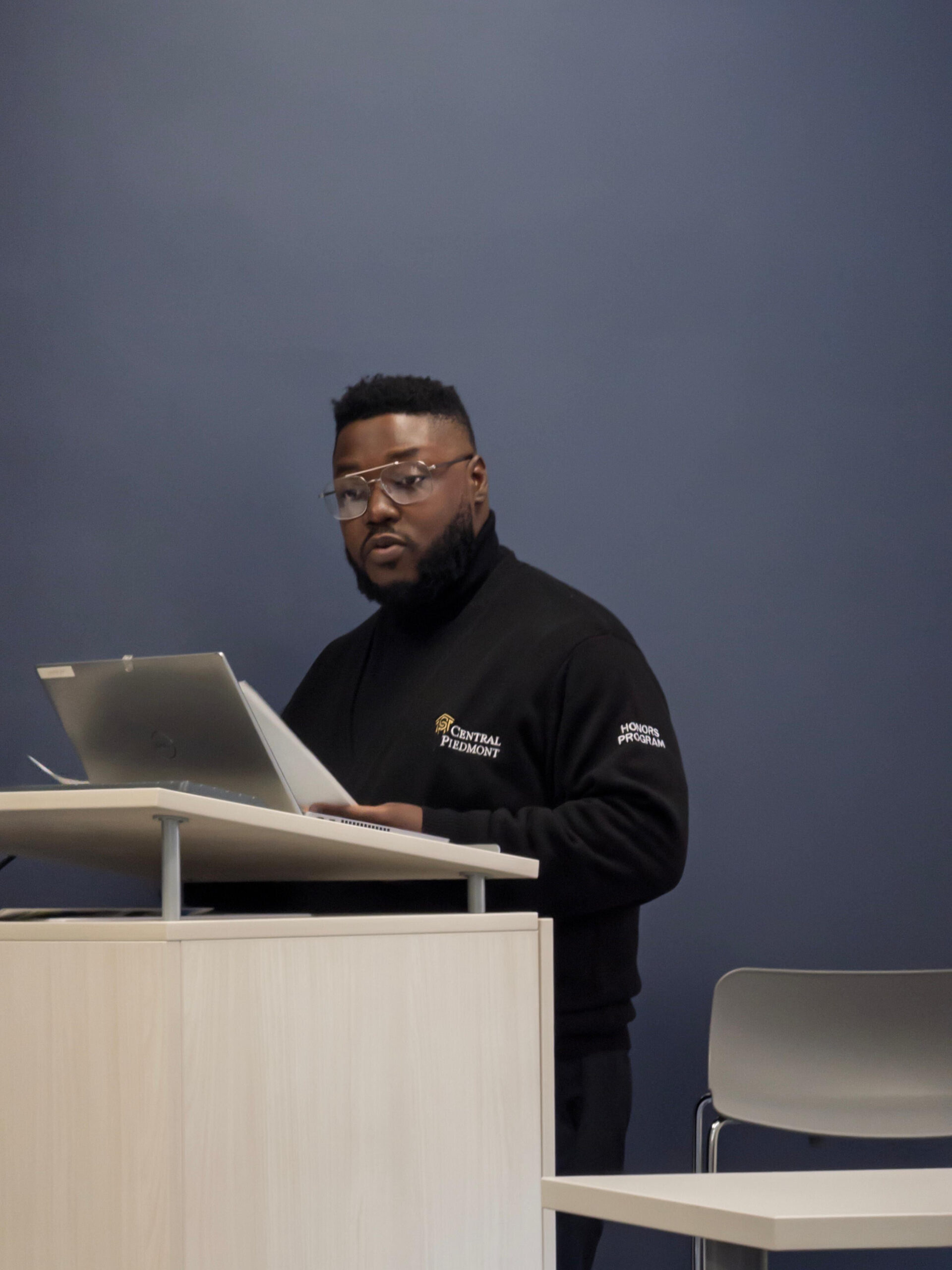
Tobin T. Pharaoh: The Rise of a New Political Philosopher in America’s Public Square
At just twenty-seven years old, Tobin T. Pharaoh has decided to become one of the most compelling emerging voices at the intersection of political philosophy, public thought, and socio-political critique. Born on September 11, 1998, in Charlotte, North Carolina, Pharaoh represents a new class of American public intellectuals—self-fashioned, interdisciplinary, fearless, and unwilling to accept the boundaries placed upon a young Black thinker seeking to reimagine the American discourse.
A graduate of Myers Park High School, Pharaoh is currently a Truist Honors Scholar at Central Piedmont Community College, where he is pursuing an Associate Degree in Nursing. His academic trajectory is intentionally rigorous and unapologetically ambitious: he plans to complete his BSN, followed by a Doctor of Nursing Practice in Psychiatry, and ultimately earn a law degree from Yale Law School with a specialization in psychiatric malpractice, behavioral health compliance, and internal investigations. For Pharaoh, academic credentials are not accolades—they are instruments of social and institutional reform.
Yet it is not only his academic pursuits that distinguish him. Rather, it is his voice, his mind, and his philosophical discipline that have begun to draw audiences throughout North Carolina and beyond. As a political philosopher, public thinker, lecturer, speechwriter, and essayist, Pharaoh brings a synthesis of psychological insight, legal reasoning, and moral critique that feels both ancient and urgently contemporary. Though he does not hold a terminal degree in philosophy, his speeches create an unmistakable impression: you are listening to a philosopher shaped by experience, precision, and intellectual hunger—one who has mastered the craft outside the academy’s walls.

Art is how we explain ourselves to the future. It carries what reason forgets — our fears, our faith, our wonder.
Tobin Pharaoh - Public Speaker
A Voice Formed at the Cracks of the American Experience
Pharaoh’s work is animated by a restless confrontation with America’s socio-political contradictions. His writings dissect the failures of institutions, the fragility of democracy, and the moral crises embedded in power structures. He approaches philosophy the way a physician approaches a patient: diagnostically, compassionately, and with an unflinching commitment to the truth.
As an essayist and speechwriter, Pharaoh’s prose is distinguished by its clarity, intensity, and structural discipline. He challenges his audiences not merely to think, but to interrogate—to question their assumptions, to confront their intellectual complacencies, and to resist the anesthetizing effects of political convenience.
His lectures are known for blending political philosophy with psychology, public policy analysis, and ethical inquiry. Those who hear him speak often remark that the experience feels less like attending a talk and more like undergoing a mental awakening. His audiences include students, professionals, activists, healthcare workers, and anyone drawn to the study of social power and institutional truth-telling.
A New Kind of American Thinker
Tobin T. Pharaoh stands at the frontier of a new generation of public philosophers—shaped not by tradition alone, but by interdisciplinary mastery and a moral clarity forged in the complexities of contemporary American life.
His rise signals a shift: that philosophy, public thought, and socio-political critique do not belong solely to the academy, nor do they require institutional permission to flourish. They belong to those bold enough to take responsibility for thought itself.
And Pharaoh has taken that responsibility with the seriousness of a man determined not only to understand the world, but to change it.
Current Academic Pursuits and Philosophical Projects
Alongside his academic training in nursing, psychiatry, and law, Tobin T. Pharaoh is constructing an intellectual portfolio centered on power, identity, and the psychological architecture of American life. His projects blend sociopolitical critique with philosophical precision, revealing a thinker intent on reshaping public discourse.
The Outliers Manifesto
The Misconceptions of Free Will and the Crisis of Self-Acceptance
In a companion essay series, Pharaoh interrogates how free will is distorted by shame, social programming, and the absence of genuine self-acceptance. He argues that many people perform autonomy rather than live it, and explores how trauma and identity shape the illusion of choice. This work fuses political philosophy with moral psychology to expose the internal barriers to authentic freedom.
The American Outrage Lectures
Set to become his defining contribution, The American Outrage Lectures offer Pharaoh’s sweeping critique of America’s contradictions—its professed democracy versus lived realities, its institutional authority versus ethical failures. Framed as a lecture series, the work dissects exceptionalism, social conditioning, and the nation’s unresolved moral trauma, approaching America as both a political entity and a psychological organism.
Together, these works reveal a young philosopher in formation—one who refuses to wait for academic permission to think boldly. Pharaoh’s emerging body of thought challenges entrenched narratives and seeks to cultivate a new vocabulary for freedom, agency, and human dignity.