
We Want Freedom (2004)
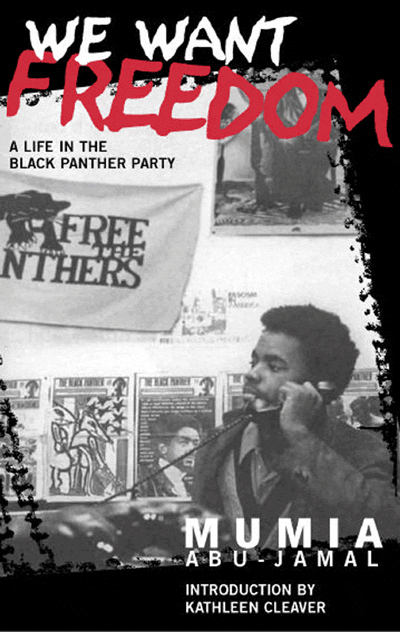
We Want Freedom (2004)
Freedom is rarely granted; it is demanded. The phrase itself—we want freedom—is not a slogan of impatience, but a declaration of clarity. It rejects gradualism, symbolic reform, and conditional justice. It names a collective refusal to wait politely for dignity.
The struggle for freedom has always been met with attempts at containment. Movements are sanitized, leaders isolated, histories rewritten to remove their sharp edges. What remains in public memory is often a version of resistance stripped of threat—celebrated only after it has been neutralized. Yet freedom, when pursued honestly, is disruptive by nature.
From the vantage point of incarceration, the architecture of repression becomes visible. Surveillance, policing, imprisonment, and political marginalization are not separate phenomena—they are coordinated responses to demands for transformation. The state tolerates reform; it fears liberation. The difference lies in whether power itself is questioned.
What emerges here is not nostalgia, but instruction. The past is not invoked to be admired, but to be understood. Victories were partial. Losses were real. Internal contradictions mattered. Yet the central demand remained consistent: control over one’s life, community, and future. Freedom was never abstract—it was material, urgent, and collective.
This work challenges the myth of progress as inevitability. Gains can be reversed. Rights can be narrowed. Language can be co-opted. Without vigilance, freedom becomes ceremonial—acknowledged rhetorically while denied in practice. The struggle must therefore be continuous, adaptive, and grounded in memory.
Freedom also demands discipline. It requires organization, political education, and sacrifice. It is not sustained by outrage alone. The temptation to personalize struggle—to reduce it to heroes or villains—obscures the systems that must be dismantled. Liberation is not a moment; it is a process.
We Want Freedom insists that the demand remains unresolved. It confronts the reader with a question that cannot be deferred: what does freedom require now, and who is being asked to wait for it? Until that question is answered honestly, the declaration stands—not as history, but as mandate.